
Requests is the single inbox for every approval in Monopam. Each request is one row for the requester and one row per approver; the approved request itself is the grant, with its time window.
|
Applies to |
Who can do this |
|---|---|
|
Monopam v2026.10 |
Every user sees Mine. Everyone needs the |
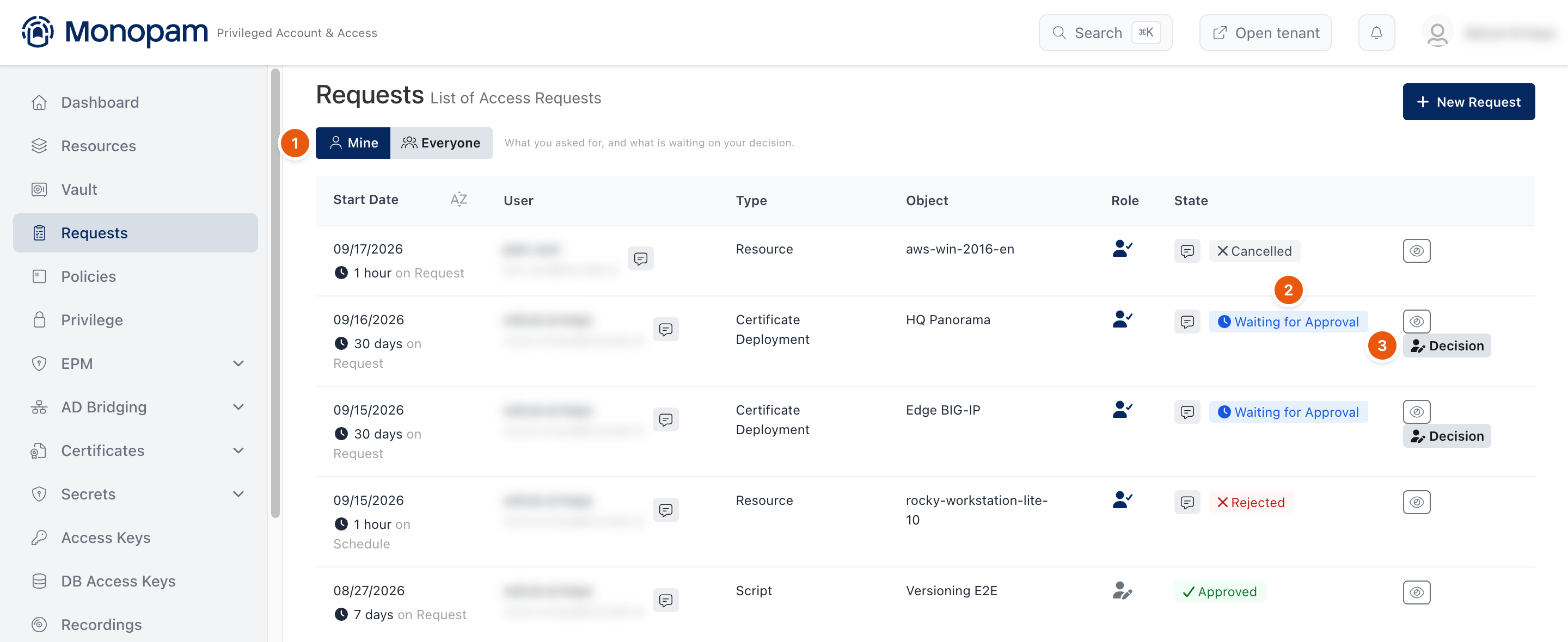
Figure 1. The Requests page.
|
Column |
Shows |
|---|---|
|
Start Date |
When the window opens, with its length and whether it starts on Request (when approved) or on Schedule. |
|
User |
The requester. The speech bubble shows the requester's description. |
|
Type |
The kind of object: Resource, Credential, Certificate, Certificate Deployment, Script, Vendor and others. |
|
Object |
The object's name, linked to its page where one exists. |
|
Role |
Whether you are the requester or an approver on this row. |
|
State |
Waiting for Approval, Approved, Rejected, Cancelled, Waiting for Service or Completed. No approver marks a request nobody was named to decide. |
Actions on a row
|
Button |
Who |
What it does |
|---|---|---|
|
Decision |
Approver |
Approve or reject. See Approve and revoke access. |
|
Cancel |
Requester |
Withdraws a request that is still waiting. |
|
Revoke |
Approver or administrator |
Ends an approved grant early and closes live sessions opened under it. |
|
Decide |
Super administrator |
Decides a request that names no approver, or overrides one in the Everyone scope. |
What can be requested
|
Request type |
Raised when |
|---|---|
|
Direct Connection, Scheduled Connection |
A user connects to a resource that requires approval. |
|
Vault Access |
A user reveals a field whose policy requires approval. |
|
Privileged Command |
A shell command is held by a privileged command rule. |
|
Database Query |
A database statement is held by Database Rules. |
|
EPM Execution |
An endpoint asks to run an application elevated. |
|
Certificate Issuance, Certificate Renewal |
A certificate operation needs approval. |
|
Script Publish, Script Execution |
A script version is published or run under an approval gate. |
|
Temporary AD Access |
A user asks for time-limited access through AD Bridging. |
|
External User Invitation, External Access Review |
Vendors and external users are invited or reviewed. |
Related
-
Request access
-
Approve and revoke access
-
Request Policy